Motion Tracking Icons for Modern Design
Visualizing complex technology requires clear, immediate symbols. When designing interfaces or educational materials related to augmented reality, the concept of motion tracking often needs a graphical representation that is instantly recognizable yet unobtrusive. A simple line element motion tracking symbol serves this exact purpose, bridging the gap between advanced spatial computing and user-friendly design. Whether you are building a landing page for a new AR app or creating an infographic explaining computer vision, having a clean, vector-based icon ensures your message lands effectively without visual clutter.
Defining Motion Tracking in Visual Communication
At its core, motion tracking is the process of matching the movement of a real-world object or camera within a digital environment. It allows virtual elements to stick to physical surfaces, rotate with objects, or respond to user gestures. However, when we discuss motion tracking in the context of graphic design and web templates, we are referring to the symbolism of this technology rather than the algorithmic process itself.
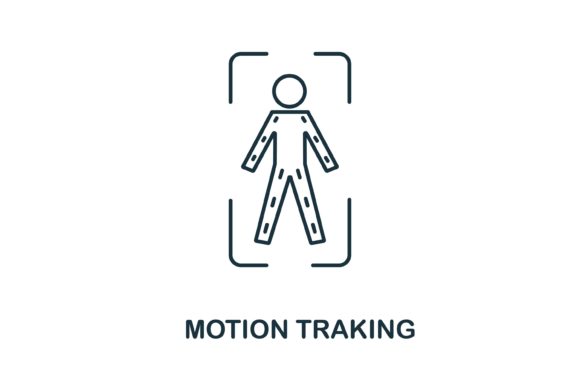
A well-designed motion tracking icon typically features crosshairs, bounding boxes, or trajectory lines. These visual cues have become the universal language for spatial awareness in digital interfaces. They tell the user, "This system sees depth," or "This content interacts with your environment." For designers, finding a symbol that captures this technical nuance without looking overly complicated is a frequent challenge. The availability of editable EPS and JPG files allows creators to adapt these symbols to fit specific brand guidelines while maintaining technical accuracy.
Diverse Priorities Across User Groups
The value of a high-quality motion tracking asset shifts dramatically depending on who is using it and why. A one-size-fits-all approach rarely works in creative workflows because the end goals vary so widely.
For Professional UI/UX Designers
Professionals working on augmented reality applications prioritize consistency and scalability. When designing an interface for a headset or mobile AR experience, every pixel matters. A vector-based motion tracking symbol is essential here because it must remain crisp across vastly different screen densities and field-of-view renderings. Professionals are less concerned with the novelty of the icon and more focused on how it integrates into a larger design system. They need assets that are easy to edit, allowing them to adjust stroke weights, corner radii, and colors to match existing style guides. Reliability and clean geometry take precedence over decorative flair.
Educators and Technical Communicators
In contrast, educators and textbook authors prioritize clarity and pedagogical value. When explaining how SLAM (Simultaneous Localization and Mapping) works to students or stakeholders, the icon serves as an anchor point for understanding. Here, the motion tracking symbol acts as a visual metaphor. An educator might prefer a slightly more illustrative version that explicitly shows the relationship between a camera lens and a tracked object. For this audience, the JPG format is often just as valuable as the EPS, as they frequently work in presentation software or learning management systems where vector editing is unnecessary. The priority is speed of implementation and immediate comprehension.
Marketers and Content Creators
Bloggers, social media managers, and marketers view motion tracking icons through the lens of engagement and trend relevance. Augmented reality is a buzzword, and visuals associated with it signal innovation. For a blog post about retail tech or a LinkedIn carousel discussing spatial computing, the icon needs to be aesthetically pleasing and modern. Marketers often look for simple line elements that feel lightweight and futuristic. Ease of use is paramount; they may not have advanced vector editing skills, so a pre-styled JPG or a highly organized EPS file saves significant time. The goal is to enhance the narrative, not to reinvent the wheel.
Evaluating Quality and Usability
Not all icon packs are created equal. When selecting a motion tracking symbol for your project, several practical factors determine whether an asset will be a helpful tool or a frustrating obstacle.
- Vector Integrity: True EPS files should contain clean paths without excessive anchor points. Bloated vector files can cause rendering issues in web browsers or slow down design software. Check that the lines are uniform and that the symbol scales down to small sizes without losing definition.
- Editability: A "simple line element" should actually be simple to modify. If the icon is flattened or rasterized within the EPS, it loses much of its utility. Ensure layers are logical and that strokes are live rather than expanded outlines, allowing for quick weight adjustments.
- Semantic Clarity: Does the symbol actually read as motion tracking? Abstract art is beautiful, but functional icons must communicate their purpose instantly. Test the icon at thumbnail size to ensure the crosshairs or tracking markers remain distinct.
- Format Versatility: Receiving both EPS and JPG formats covers the widest range of use cases. The EPS serves as the master source for print and high-res displays, while the JPG provides immediate compatibility for documents, emails, and quick mockups.
Practical Applications in Modern Projects
Understanding where and how to deploy these symbols helps maximize their effectiveness. The context dictates the style and placement.
Web Design and Landing Pages: On a website promoting AR services, motion tracking icons often appear in feature grids or step-by-step tutorials. Using a consistent line weight across all icons in the set creates visual harmony. Here, the symbol might be paired with short copy explaining capabilities like "Surface Detection" or "Object Anchoring." The minimalist nature of line icons prevents them from competing with product screenshots or hero videos.
Infographics and Data Visualization: When mapping out the workflow of an AR experience, motion tracking symbols serve as nodes in a flowchart. They help distinguish between different types of sensor inputs or processing stages. In this context, the ability to change the color of the vector file is crucial for color-coding different sections of the diagram. A monochromatic line icon can be easily tinted to match categorical colors without losing its identity.
Video Overlays and Streaming: Content creators producing tutorials or tech reviews often use these symbols as lower-thirds or transition elements. Because video resolution varies, having a scalable vector source ensures the graphic looks sharp whether rendered in 1080p or 4K. The association of the tracking reticle with "tech analysis" has become a visual shorthand that viewers intuitively understand.
Matching Assets to Your Skill Level
Selecting the right motion tracking resource also depends on your current proficiency with design tools. Beginners or those outside the design field should focus on the ready-to-use JPG versions or EPS files that require minimal manipulation. These assets provide professional polish without demanding hours of learning curve. The priority here is accessibility and immediate results.
Intermediate users and freelancers often benefit most from the editable nature of the EPS format. You might need to combine the motion tracking symbol with other elements to create a custom logo or badge. Having clean, separated paths allows for this hybrid creativity without starting from scratch. This flexibility extends the commercial value of the asset, as it can be repurposed across multiple client projects.
Advanced professionals and agencies treat these icons as foundational components. You might deconstruct the symbol entirely, using its geometry to build custom animations or interactive web elements. For this group, the structural quality of the vector file is the primary evaluation metric. You are looking for mathematical precision that supports further development rather than just static decoration.
Making the Right Choice for Your Goals
Ultimately, the decision to incorporate a specific motion tracking icon should align with your project's broader objectives. If your goal is to educate, prioritize semantic clarity and standard representations. If your goal is to sell or market, prioritize aesthetic alignment with current design trends. If your goal is to build a functional product, prioritize technical scalability and integration potential.
The availability of both EPS and JPG formats in a single package addresses the reality that creative needs are fluid. You might start with a JPG for a quick pitch deck and later refine the EPS for the final website launch. This versatility reduces friction in the creative process, allowing you to focus on communicating the transformative potential of augmented reality rather than struggling with inadequate graphics. By choosing assets that balance simplicity with professional-grade editability, you ensure that your visual communication remains as dynamic and responsive as the technology it represents.